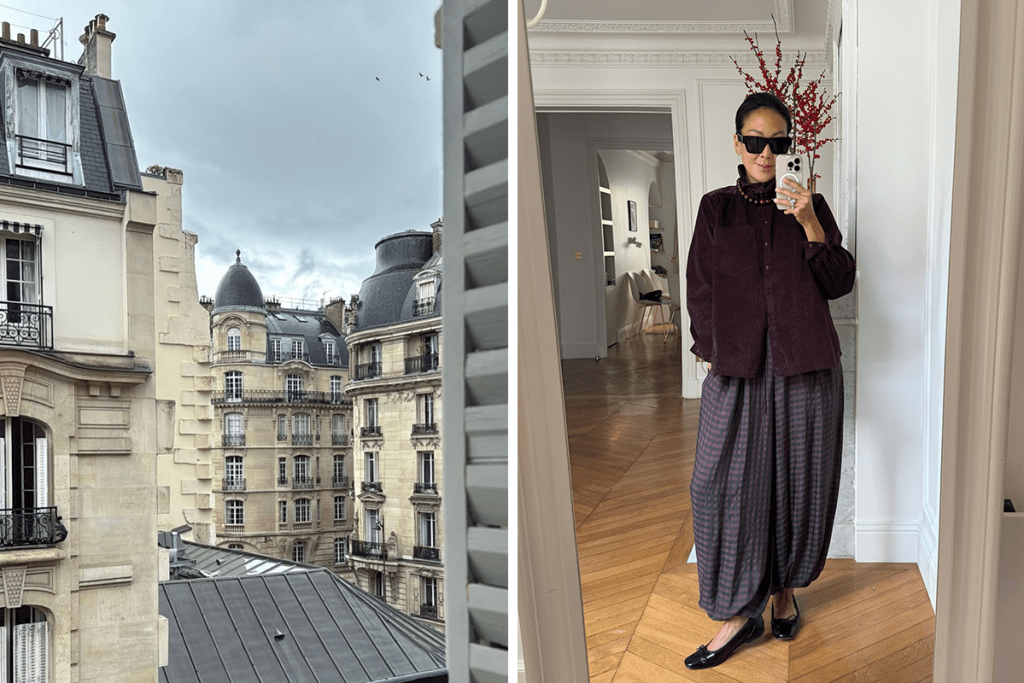
Stylist and editor Irene Kim writes one of our favorite fashion Substacks, In Moda Veritas, sharing her unfussy yet elevated approach to style. Originally from Canada, her family realized it was “now or never” to follow their dream of moving from Toronto to Paris, and finally made the leap this summer after a year of sorting out visas, schools, bank accounts, and a tangle of French bureaucracy. The pay-off has been a slower pace, culture woven into the everyday, and the ease of traveling throughout Europe. Read on for all the details of their move—including the logistics of getting her incredible wardrobe across an ocean—and how you can do it, too.
What inspired your move to Paris?
It was a vibe I picked up the very first time I visited over 20 years ago. Paris is romanticized for a lot of things, but what really drew me in was the general mood and emotional temperature of the people. There’s a reserve here. People are slower to warm, but there’s also a real value placed on conversation and debate. That slower, more thoughtful social energy just felt right to me. Of course, there were other things that made living here appealing. Culture in all its forms is woven into everyday life. Travel is easier and more accessible than from Toronto. Overall, Paris had just the right mix of what I was looking for in a city I wanted to live in.
That was 20 years ago, and while I’d visited Paris and France many times since, I finally made the move from Toronto in July 2025 with my husband and two sons. I still appreciate all of the things that initially drew me in, but now there’s the added layer of wanting to experience this together, as a family. It helps that we all speak varying levels of French already.
What was that process like as a Canadian? Did you work with a person/service in France or navigate it all on your own? Could you share a bit about the visa process?
We contacted a lawyer over a year before our intended move date so we could get a clear idea of what entry options were available to us. I’d strongly recommend speaking to a French immigration lawyer early on—even if it’s just a one-hour consultation—to get an accurate picture of your visa options. You don’t necessarily need someone to handle your entire application, but having a professional walk you through the process can save a lot of time and stress. There’s so much conflicting information floating around online, especially in Facebook groups, and it’s easy to get led in the wrong direction. For us, the VLS-TS (long-stay visa) made the most sense. It’s renewable each year for up to five years, and the checklist for our specific visa type is fairly straightforward. We just worked through it one step at a time.
Looking back, you could probably get it all done in three months if you really had to. But if you can, I’d give yourself at least a year—not just to deal with paperwork, but to emotionally and physically prepare. That includes things like renting or selling your home, downsizing or storing your belongings, sorting out school or work logistics, getting your finances in order, and saying your goodbyes.
Did you learn about any surprising visa hacks/loopholes worth sharing?
Not applicable to us, but I learned that when applying for a VISA, not to write “moving to be with a boyfriend/girlfriend.” Apparently French authorities are well aware of how often those situations don’t last!
What about the nitty-gritty stuff—enrolling your kids in school, bank accounts, phone service—did you sort that out before you left, or once you were in Paris? What about housing?
I found a few aspects of the relocation process to be tricky because they created these frustrating chicken-and-egg situations.
First, we could only apply for our visa three months before our intended entry into France. That means we could spend a year getting our house ready to rent/sell, research and pay for schools, etc… only to have our visa denied. That uncertainty definitely weighed on me. Again, this is where speaking with an immigration lawyer is really helpful to give you a realistic assessment of your chances and help you prepare a stronger application.
For our visa, we needed to show proof of accommodation, but getting a lease in France is notoriously difficult if you’re coming from abroad. Most landlords require a French guarantor and proof of income that’s 3x the rent. On top of that, Paris rentals tend to hit the market only about a month before the move-in date, which makes it tough to line up a lease before you submit your visa application.
To help us through this gauntlet, we contacted real estate agents early, like in August 2024. They all laughed and told me to call back in May 2025. Hoping I could sort out our rental before we submitted our visa application, I tried again in March and we were very lucky to secure our place in April for a mid-July move-in. Our back-up plan was to stay with friends who were willing to sign a declaration stating we’d be living with them, which is allowed under our visa. Another common workaround is to book an Airbnb for three months and look for long-term housing once you’re here. Another chicken-and-egg: I needed to show my signed lease to open a bank account and get a phone number, which I did within the first days I arrived. I’m not sure what you would do if you don’t have your lease sorted out yet.
Figuring out schooling took up most of my time. Our sons were entering Grades 4 and 6 and I ideally wanted them to be in the same school and one that was primarily French. In the Paris public system, grade 6 is collège (middle school) which is separate from primary school, so that motivated us to find a school that would take both. We’ve always been in the public school system in Toronto, so applying for private and semi-private schools was way more time-consuming than I expected. Most of the schools we applied to were 100% French, which meant I needed to get all the boys’ report cards and documents translated at a significant cost. Application deadlines were in fall 2024 for the 2025-26 school year, so the research had to happen well before finding housing or applying for your visa. If you don’t go the public school route, your choice of school will probably determine the area you’ll want to live in.
Is there anything you wish you knew before you made the move?
Other than knowing more French, no, not really. For the big pillars, we were as prepared as we could be. For the rest of it, the fun is in figuring it out as you go.
How is your French? Have you found any helpful resources or tricks to practice?
My French is OK. I learned French throughout school and have done Alliance Francaise on-and-off. Because I studied French academically, my reading and writing is decent, but my spoken French—which never gets practice—is pretty rusty. Having grown up in New Brunswick, my husband is fairly fluent. Did you know that New Brunswick is the only official bilingual province in Canada? It’s not Quebec! My kids were in French immersion in Toronto, so at least they have a base. I’m in a conversation group and when things settle down, I’ll begin Alliance Francaise again.
As a stylist you have an amazing (and presumably large) wardrobe, how did you manage to move all of that across an ocean?
Oh man, I wrote two newsletters about this (Part one and two).
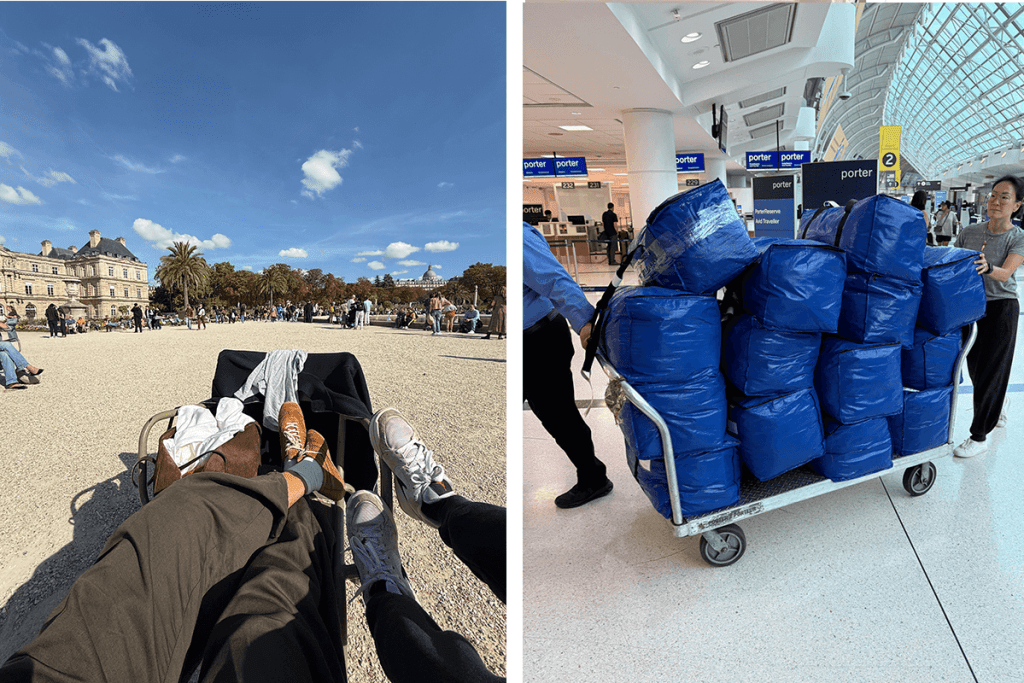
Part of moving from Toronto to Paris is accepting that people live more densely and in smaller spaces. Our Paris apartment is 1/3 the size of our Toronto home and we have no yard here. Early on, I foolishly thought I’d be taking my entire wardrobe, reasoning that clothes are my job, so of course I needed to take it all! In the end, I ended up giving away or consigning 75% of my wardrobe. I decided that this was a rare opportunity to only keep what I loved without qualification, even if it left a “gap” in my closet. It didn’t matter if I “needed” it and didn’t have something similar in cut, color, or utility. Even then, my wardrobe (including shoes, coats, accessories) took up 10 of these bags. We moved with 16 checked-in blue bags, four carry-ons and four personal items.
Beyond your wardrobe—did you bring furniture/art/books, or start fresh?
We didn’t bring any furniture, because we moved into a fully furnished home that has all the basics, and at the same time, we rented out our Toronto home. We left all our art, books, etc… for our tenants. By comparison, our Paris apartment feels far from lived-in, and I’m having a hard time deciding what to invest in when we’re not sure how long we’re staying (we’re taking it one year at a time!). We brought probably one suitcase worth of sentimental items like our wedding photo, quilts made by grandma, a few of the boys’ favorite books and toys.
Has the move influenced your work as a stylist? Has Paris changed how you dress or the way you approach your projects?
I decided when I moved here that I would continue with my Substack, In Moda Veritas, but scale back on my style consulting until the new year. I want and need the time just to observe and absorb all that is new around me, while also taking the extra time to settle in my family. Come the new year, I’m curious to see how being here will influence my work going forward.
It’s only been a couple of months, but unsurprisingly, I’ve been especially attuned to how people dress in Paris. There’s a discernible difference here from style codes I’m used to back home, and from what I see in other fashion capitals like New York, London, and Tokyo. What immediately stood out is that what’s considered “casual” here feels more elevated than at home. My wardrobe goes from sweatpants to skirts with very little in between, and my Tibi Calder joggers were my faithful go-tos for just about everything. In North America, loungewear has been fully absorbed into the style lexicon, but in Paris, sweatpants tend to remain in the domain of gyms and homes. It’s not that people are in heels and fancy ensembles at 9am; in fact, sneakers are absolutely the norm here. Casual looks different, and I’ve had to invest in some everyday jeans and bottoms.
Any surprising things you’ve learned about culture/life in France?
There’s this impression in North America that the French (and Italians) know how to enjoy life with their morning cappuccinos, leisurely lunches and many vacation days. Vacation is definitely sacred here, but my impression is that the French work long and hard hours. The grass isn’t always greener!
It’s only been a few months, but do you have any neighborhood favorites so far?
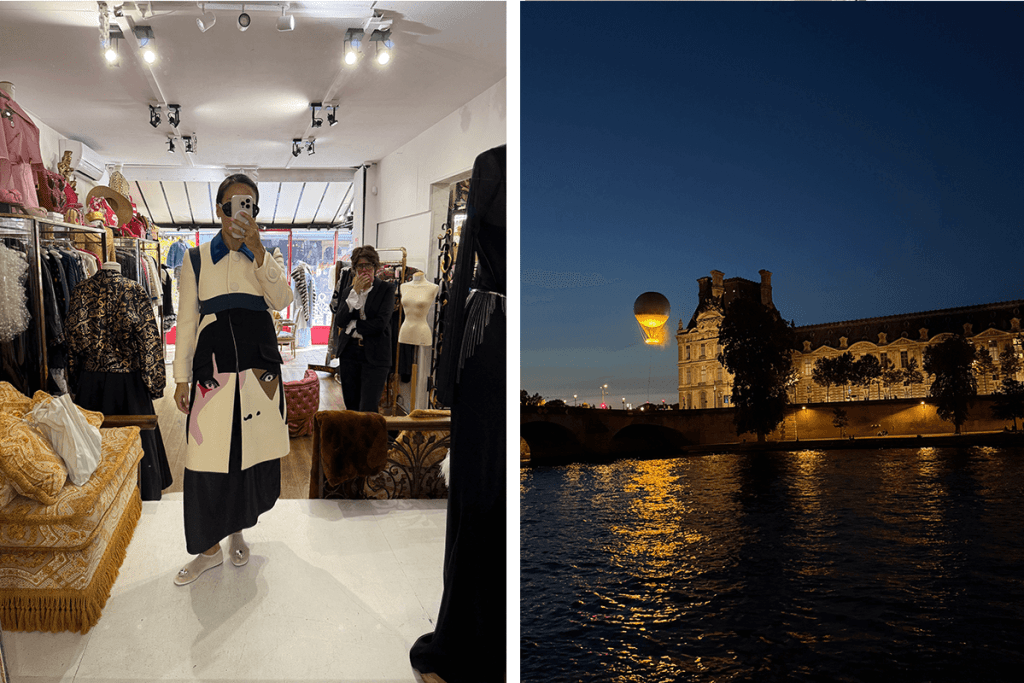
To be honest, I’ve barely left the neighborhood! There’s so much involved in settling in the family, getting your apartment together, developing routines….
It’s been an adjustment for the boys especially to live in an apartment and be mindful of how much noise they’re making. We’ve already gotten complaints from the neighbors! We’re trying, but they need to get their energy out. Expansive green space is hard to come by in Paris, so I love living near Bois du Boulogne and being able to go there a few times a week.
I love the fish markets! I seem to come across them all over the city, and every time I do, it’s settled, that’s our dinner for the night.
I love that I can walk out my door and I have five grocery stores, five cafés, and 15 restaurants within 100m. We lived pretty centrally in Toronto and the nearest anything was a 10-minute walk.
What’s on your personal Paris bucket list for the next year?
I have a long list relating to the shops I want to visit. There are so many brands here and I want to see as much as I can. All the secondhand shops! Les Puces de Saint Ouen at least once a month. The Singer exhibition at Musée d’Orsay. And just exploring and discovering things with my family.
Leave a Reply
You must be logged in to post a comment.