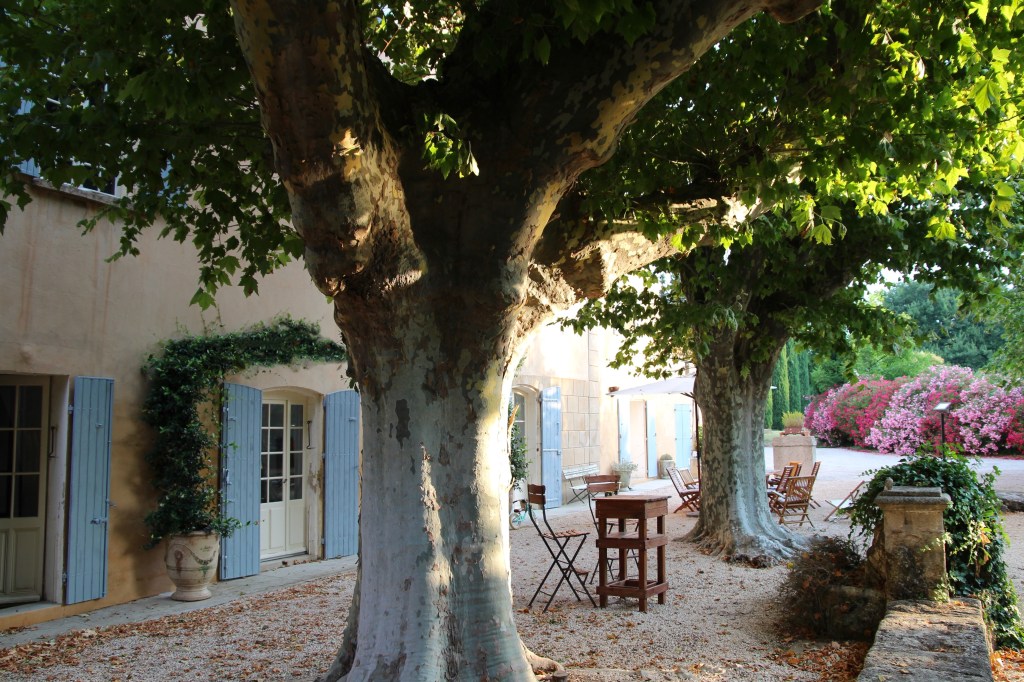
Emilie Joly Johnson did what so many people dream of—leaving her corporate job in New York City for a more pastoral life in Provence. We fell in love with her Instagram account, where she posts the dreamiest photos of the 16th-century bastide that she now calls home, and wanted to hear more about her story. Now a writer, photographer and avid yogi, Emilie lives an inspiringly barefoot life with her young family in the Provençal countryside. Luckily, she’s sharing how she made the leap and what she wishes she’d known beforehand—just in case there are any bastides you’ve got your eye on.
What inspired your move to Provence?
On a glacial New York January day in 2016, my husband, Xavier, and I went to lunch near our offices on Park Avenue, where we both worked in finance. Chilled to the bone, we spent the lunch dreaming of a place where one does not have to steel against the cold for months of the year. Our girls were 2 and 4; school was approaching and our own lives felt frenzied. I was stretched thin. I would bike to work early in the morning and race home at night to squeeze in what time was possible with the little ones. I felt like I was never wholly anywhere…at work I was torn; at home I pined for more time, and everywhere I was soaked in guilt.
Early in our relationship, we had lived in Paris for 3 years before moving back to New York. We considered moving back to Paris, but even the profound beauty of that city is not untouched by the monotonous gray skies that tarry. We roamed the hexagon…Aquitaine? La Rochelle? My eyes brightened as I pronounced, Aix-en-Provence and let the lovely place hang in the air between us. I had studied in Aix as a student and had returned as an adult to work in the south of France, the light and silky quality of life had cast its spell on me. Xavier grew up in Paris, but had spent all of his childhood summers at a family home on the Côte d’Azur. So, the idea was sowed. We spent the next few months sending each other dreamy property listings in Provence and fast forward to April…we were committed.
We took a weekend trip to Provence, and working with a real estate broker we drew a loose circle around Aix-en-Provence, explaining that we wanted to find an old home with land around it, 200 years old or older, please. She said that she wanted to show us something that was on the high end of our budget, but that we really should see. She led us to what is our home today. It was a coup de coeur (love at first sight). The entry to the house follows a lane of plane trees and then a gravel path. We found ourselves standing in the yard of this 400-year-old bastide filled with awe. We made an offer that day. And when we came home, we put our house in Harlem on the market and soon after, quit our jobs.
What was that process like as a foreigner? Did you work with a person/service in France or navigate it all on your own?
Moving back to France for us wasn’t a struggle on an administrative level. We all, thankfully, had French and American passports, which made work and visa considerations null. My husband also happens to be an administrative whiz. The process of enrolling our family in the public health and education systems in France would have been a painful one for me on my own.
What about the nitty gritty stuff, like sending your kids to school. Did you sort that out before you left New York, or once you were in France?
One of our big considerations in deciding to uproot our life and move the girls to France was support offered in raising children. In France, children are essentially guaranteed care from the time they are babies. Mothers work. All of my guilt-drenched existence sort of melted away moving to a country where care infrastructure is firmly in place and is never questioned.
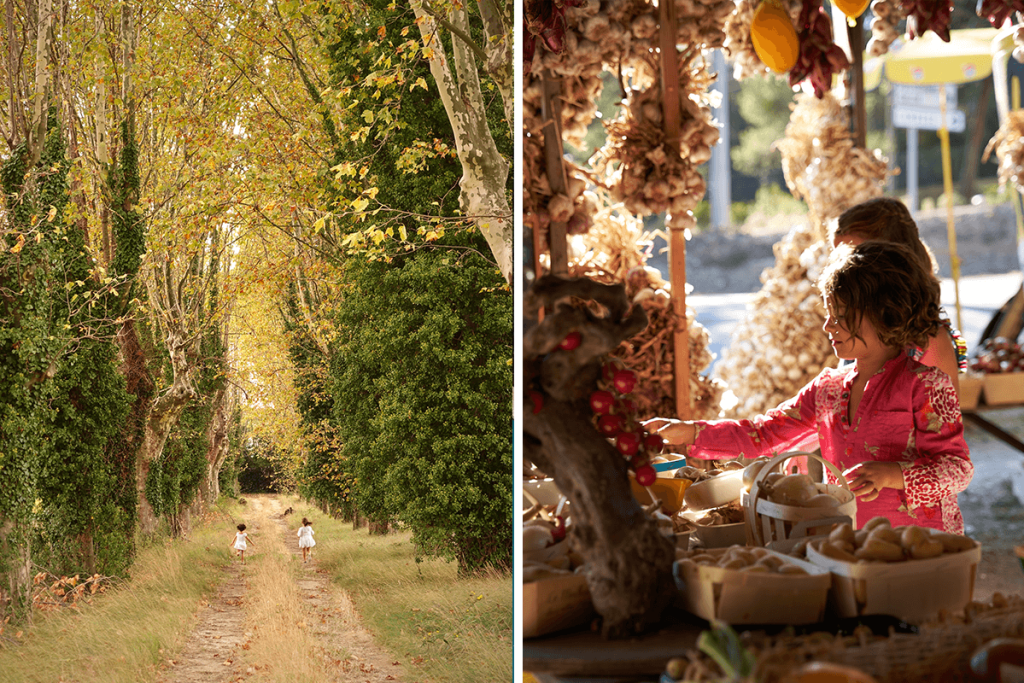
We arrived in July 2016 and the girls were in public childcare that fall. Xavier had always spoken to the girls in French, but they often replied to him in English. Colette, who was 4, was terrified she wouldn’t be able to find her words. I remember us dropping her off at school and feeling as daunted as she did but her words came at a lightning pace…within two months she was as French as she was ever American. We were committed to putting our girls in local public schools and, nearly ten years down the road, do not regret the decision.
Tell us more about finding and renovating your 400-year-old house. Did you have previous experience with that?
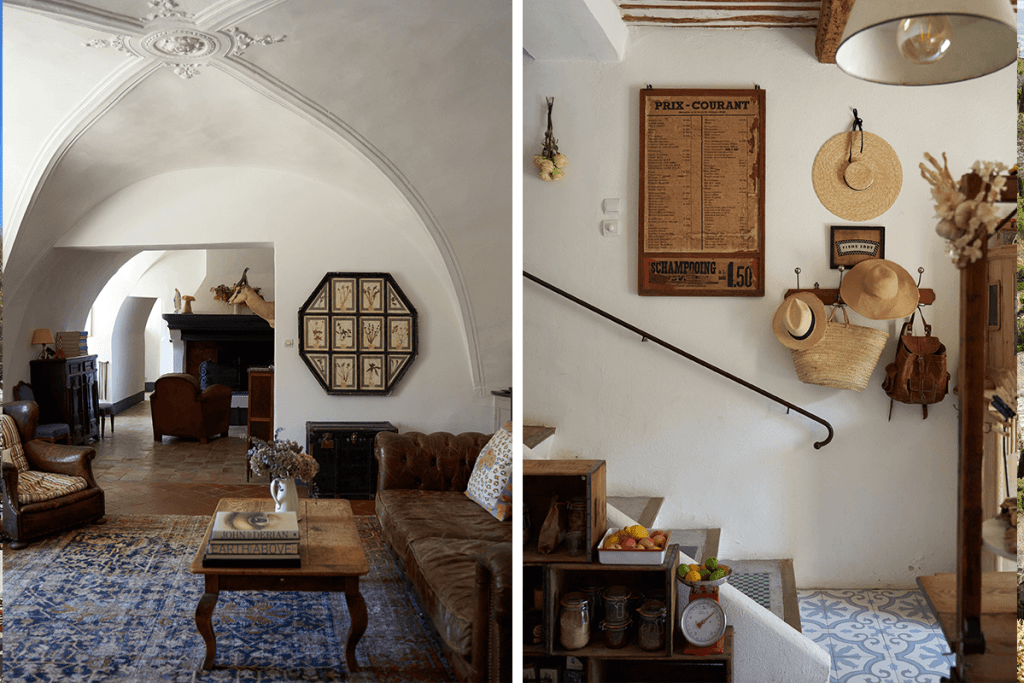
Our house and yard set the stage for our life. They are quintessentially of this region, so we feel deeply rooted here. The house is a bastide and was built in the 16th century. This type of architecture is typical in the south of France—manor houses with symmetrical facades, often built with a basin in front. The walls are a meter thick of ashlar stone, the floors are beautiful old terra-cotta traditional tiles called tomettes, and glass in the window panes is warped in places where it is still original. There’s a rustic simplicity—the ceiling beams in our kitchen and dining room are wooden slats left exposed and bear the patina of time. The key to our front door is a wrought-iron skeleton key larger than my hand. The property is bursting with trees—blossoming in the spring (apricot, cherry, pear, apple, plum) and we have a proper olive grove with 25 trees.
We were fortunate that the owners just before us did the heavy-lift renovations—electricity and plumbing. We fell in love with the bones of the house and the aesthetic as it was. The house had changed hands infrequently, so the design elements of its origins are largely intact. We didn’t want to modernize in the way of many foreigners who come to Provence and gut/render a very old place more comfortable, but in so doing, strip much of its charm. Winters are cold in our house, as these bastides were built as summer homes for the wealthy of past eras. We wear scarves in the house and are grateful for the thick stone walls when the summer months come with their heat, and we still get a rush of cool air as we walk inside.
We have done many renovation projects, with the aim of preserving as much of the original state as possible. We added a window to the dark vaulted dining room, we re-tiled two rooms with traditional tomette tiles that had been sullied with formica tiling in the ‘50s after the war. We had an Italian painter essentially living with us for the first 3 months…he artfully repaired cracks and repainted nearly all of our walls. He would come with his supplies, including a trove of boar-haired paint brushes (which he was convinced transmitted the paint more artfully). He would talk to the walls as he painted—a sing-song Italian serenade.
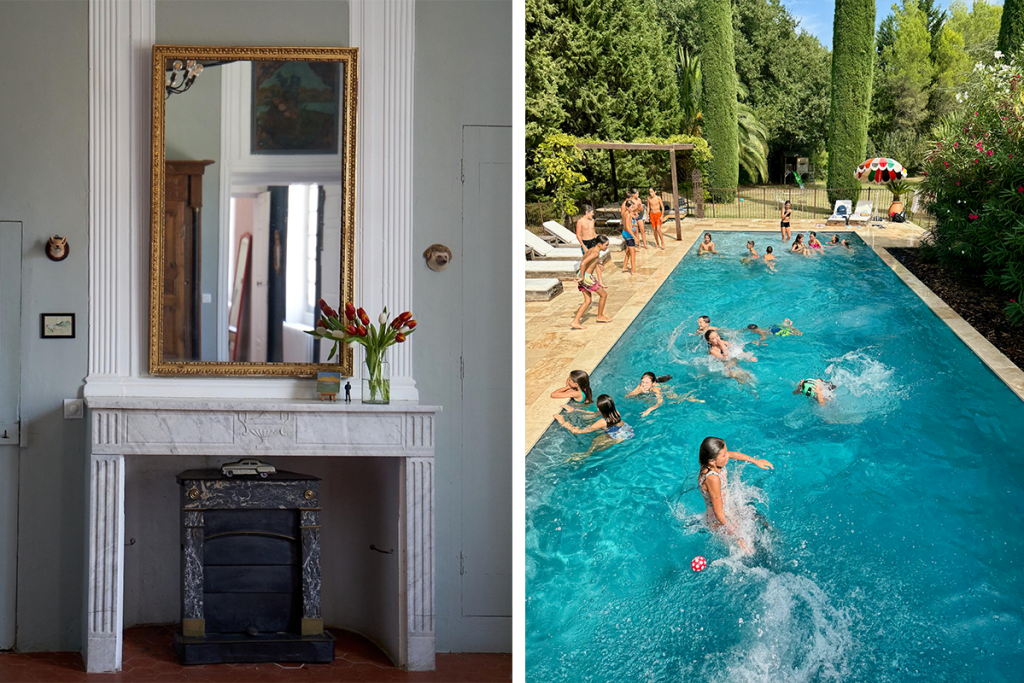
The one space we allowed ourselves to re-craft in an entirely modern way was the swimming pool. There was already a pool from the ‘90s put in, some distance from the house. The placement was perfect as we didn’t want a pool as the main spectacle from the windows. We dreamed big and rebuilt it entirely. I am a water animal and swim in it all year, even unheated in the winter months.
Is there anything you wish you knew before you started that project?
We owned a townhouse in Manhattan, so we were familiar with the upkeep required in home ownership. This house and property, however, are another level. Xavier is a keen bricoleur (handyman) and loves to take on projects small and large. Even he is daunted at times by the enormity and regularity of required maintenance. We are all truly in love with the house and can’t imagine life elsewhere, but we feel the weight of its preservation and upkeep. Seemingly simple projects like the olive harvest in the fall months is a big lift. We love the oil we can give to guests when they come to stay, but it isn’t without toil.
Any surprising things you’ve learned about culture/life in France?
We had spent three years in Paris when we were first together, so I was quite steeped in French culture before moving to Provence. Coming here was a pleasant cultural surprise for me, as the French in the south aren’t stingy with their smiles and the ever-present sun seems to warm their hearts. To be fair, my French was very good when we arrived this time around, which may account for the difference in feeling (when we moved to Paris in 2007, I found the French to be difficult). I dare say that Provence is a different country than Paris.
With the French, language is primordial. Those who have fully embraced French and speak well, do well. It is that simple. I don’t think one can live in France and have an authentic and integrated experience without truly speaking the language.
The culture of the south of France is driven by an intransigence toward adopting a modern pace. Even in Marseille, France’s second-largest city, people will not be rushed. Coming from Manhattan, when we first arrived I had to employ deep breathing techniques at the market when the vendor would spend ten minutes discussing his mother’s health situation, when all I wanted to do was buy a scoop of olives. Today, I relish the tempo.
Food was a significant motivating factor in moving back to France. I have given myself to food here. I mean that on all levels. To me, that means both indulgence and deep restraint because the two inform a sensual relationship with food. French pleasure is epicurean in the sense that sometimes the best way to achieve pleasure is through restraint.
Our village, like all villages, has a bustling twice-weekly market that is replete with seasonal bounty, straight from the earth. Like with the pace of life, there is no sense of urgency in food. In fact, for the French, food is and should be inconvenient. The notion that food requires care and measured preparation gives a reverence to the act of eating.
How have you been received by locals? What has it been like for your kids to grow up here?
I have been received with open arms by the people in my village. It took a couple of years to demonstrate our commitment to staying, and there were moments of feeling lonesome, but once we were truly established, my circle of friends expanded and continues to grow. My broad smile helps soften the fact that I am still American (a status which, while cliché, does prompt disdain in France).
Most of my life is in French. While I do have a few very close anglo friends, I came and gave myself entirely to the people here in our village, fellow parents, teachers, anyone I met. We go to the market on Fridays and it is a social affair. On Sunday mornings, I invite those from the village who would like to do yoga for a class in our yard (bless Provence’s climate that allows us to do this almost uninterrupted throughout the year). There are often 25 mats spread out on the grass in the shade of our colossal oak tree.
French schools are strict, and at first I resisted that, but I have come around. I see cultural trends in America where children essentially run the show—at home, at school, in all spaces. The French have successfully kept a dividing line between the world of adults and the world of children, which requires authority. After nearly 10 years here, I find there is a healthy balance for our girls.
That said, I am most proud of offering a wild childhood to our girls. They spend their time outside of school in wild places. They are native to the scents of Provence—jasmine, rosemary, linden flower, fig, grape and citrus blossoms, the baked earth of August. We’ve hosted two bee swarms chez nous, we have a master bug collection, bats fly into our house through the open windows in the evening. The girls know the cadence of wild things. To me, this is our greatest success in moving here.
Do you have any favorite discoveries in Provence?
Where to begin?! This list is a long one (and I am always posting things I discover – feel free to follow along).
Maison Weibel in Aix-en-Provence defines pâtisseries as art – ogle the lineup of masterpieces in the window at Weibel; eat many.
The Granet XXe Collection Jean Planque showcases a unique compilation of many of the most pivotal artists of the 20th century in a beautifully renovated 16th-century Carmelite White Penitent Brothers Chapel in Aix-en-Provence. A gem.
The gentlemen at La Méduse in Aix-en-Provence are skilled guides, passionate about each bottle in their collection. This bar à vin is tucked away and the pairing of perfect style, wine and delicious morsels of food is divine.
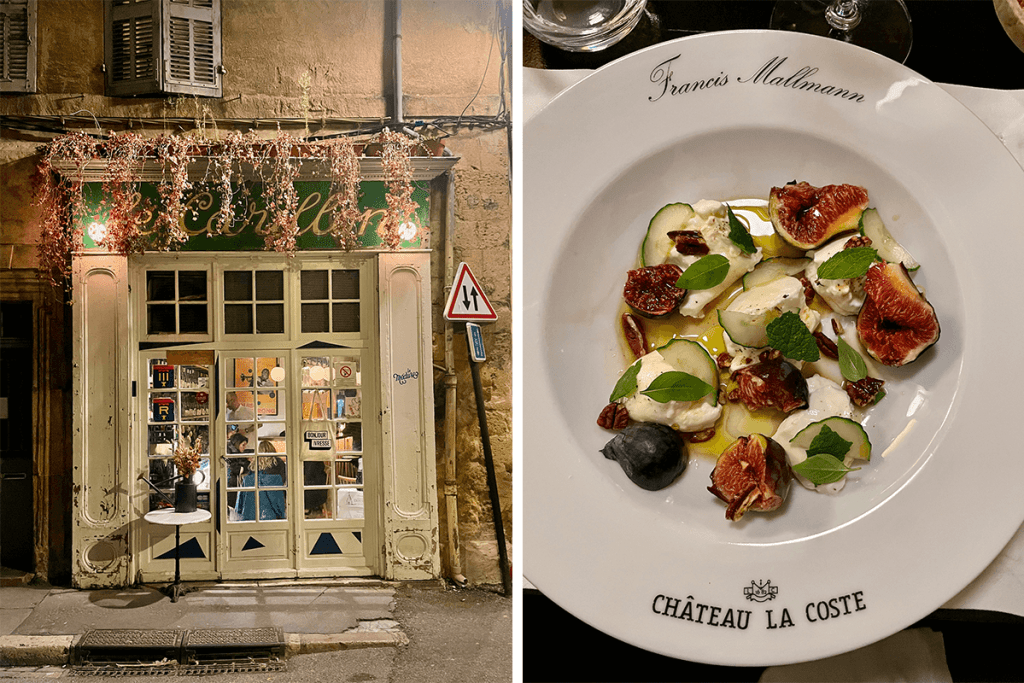
Francis Mallmann’s open-fire, Argentinian wonder kitchen is a gift. Don’t pass up the opportunity for a meal here at Château La Coste. The domain is exquisite—the world’s best artists’ oeuvres planted among the vines.
Les Goudes is a fisherman’s village, an outcrop of Marseille, and its most beautiful bit, on the cusp of the Calanques National Park.
Tuba Club in Les Goudes is the hotspot of chic in Marseille. Its position on the sea (sunsets are divine here), its panache and delicious hyper-fresh seafood make it the perfect destination. Also a small boutique hotel.
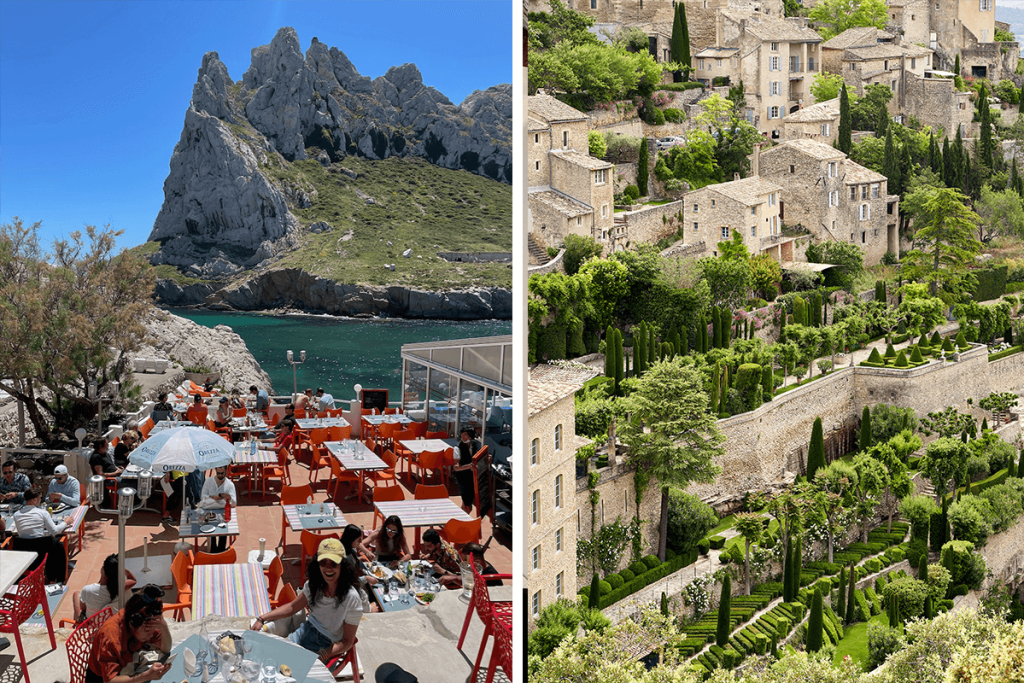
La Baie des Singes sits at the very end of the land in Les Goudes, a point called Cap Croisette. Enjoy the spectacle of the Ile Maïre just facing the peninsula—its swoop of rock like an enormous sculpture, the turquoise water in beautiful contrast below. Have a meal here—rent a lounger and spend the day in paradise.
The light in the Luberon Valley stains the villages, alleys of plane trees and row after row of grapevine aurelian. Cobblestone streets, tiled roofs and stone homes decorated with wooden shutters seem to be painted in the hues of Van Gogh. A glorious circuit through the Luberon includes the villages of Oppède-le-Vieux, Ménerbes, Bonnieux and Lacoste. In each one, climb its ramparts to the highest point—usually a château or church—for a panoramic vista that will steal your breath away. Then duck into the chill of the ancient structure to breathe in an intoxicating mix of musky resin that saturates the stone. Many of the churches in the Luberon feature original paintings on their stone walls.
Have a meal on the terrasse of L’Orangerie at Airelles Gordes, La Bastide. The view of the terraced medieval village is to-die-for.
A perfect terrace for a summer meal and apéro, Le Domaine de Fontenille is nested among the vines of the Luberon. Also a lovely boutique hotel.
Any can’t-miss experiences for visitors?
All along France’s coasts, there is a public walking path called the Sentier du Littoral. Set out—the visually poetic stretches of this path are abundant. The path along the coast in the Calanques between Marseille and Cassis is one of the most sublime.
Gallifet is a beautiful art center and exquisite restaurant in the heart of Aix-en-Provence. Showcased in a private Bastide, Gallifet features some of the best contemporary artists in France. They offer creative workshops, like this one, where we learned to use indigo for dying materials.
The fish market along the View Port in Marseille is legendary. Boats pull up and local fishermen drag their nets out— fish flailing about. Strike up a conversation with one of these guys – they love the sea, each other and are passionate about the fish they catch. They will likely give you their take on the best bouillabaisse recipe.
The first Sunday of August in Provence brings a true feast for the eyes: the floating market in L’Isle-sur-la-Sorgue. Boats brim with fare and beautiful people. A carnival of colors is laid out: market vendors float on their wooden barques peddling sunflowers, melons, nectarines, green beans, olives, wine, tapenade, fresh eggs (with their chickens on board). Ruby red lips, straw hats, Provençale attire. A painting.
In charming Saint-Rémy-de-Provence, Jane Satow guides visitors through a culinary voyage. “Dis-moi ce que tu manges, je te dirai qui tu es.” (Tell me what you eat, I will tell you who you are)…Jane’s favorite French proverb as her guide. A wonderful moment in Provençal cooking.
Rose et Marius is a luxury perfume brand born in Provence. One can take a voyage through the history of perfume and create a custom scent at their perfume workshop.
Rent a lovely convertible to drive through Provence. The light is incomparable, the tree-lined roads, the fields of flowers, the perfume of those fields!
What advice would you give to someone considering making a move abroad?
Humility. Curiosity. Flexibility. Patience. Focus on what is right under your nose. If your life is guided by a great degree of control, a move abroad might not be compatible. Make sure you have a solid partnership for such a move…a move abroad can push the limits of any couple’s relationship—or it can help it flourish, but the foundation is key.
For me, our move abroad was one toward nature. Time is made of something new here for me. It is unrooted. Less tangible. Cut loose. We have reworked our notion of luxury…now it has nothing to do with the handbag I carry or the exclusive indulgences of our city life. Luxury has been redefined as freshly-laid blue eggs—feathers still attached, a bouquet of mimosa, a neighbor’s basket of picked cherries, burying our nose in our lemon blossoms, lingering meals under a crescent moon, weekly swims in the Mediterranean, a daisy-lawn, a game of pétanque en famille, being moon-led, star-led and mostly barefoot.
Leave a Reply
You must be logged in to post a comment.