“Why are you here?” was a valid, if frank, question my tour guide Daniela asked me when I was the only one who showed up for her Bucharest walking tour on a Sunday in late September. I couldn’t pinpoint what drew me to Romania, but I’d been thinking about it for almost a decade. When I was studying Sustainable Development in Scotland, I learned that Romania is home to nearly two-thirds of Europe’s remaining old-growth forests, and might be one of the last places on the continent that still feels truly wild. Later, while staying at Killiehuntly, one of my favorite hotels in Scotland, someone compared Transylvania—a historical region in northwestern Romania—to what the Scottish Highlands might have looked like two hundred years ago, before industry degraded the land and the apex predators were hunted to extinction.
Then I heard that Wildland, the conservation organization behind Killiehuntly, had purchased land in Transylvania, and that the King of England had been visiting for decades, restoring houses in tiny villages and taking walks in the Zalan Valley where nobody recognized him. I figured they must be onto something, and I was curious to find out what that was. Fast forward to this fall, I finally planned a trip and convinced a few friends to join me. The week before, I got two apologetic texts saying they couldn’t make it. Maybe the trip was doomed, but the idea had been simmering too long. So I went alone.
Bucharest
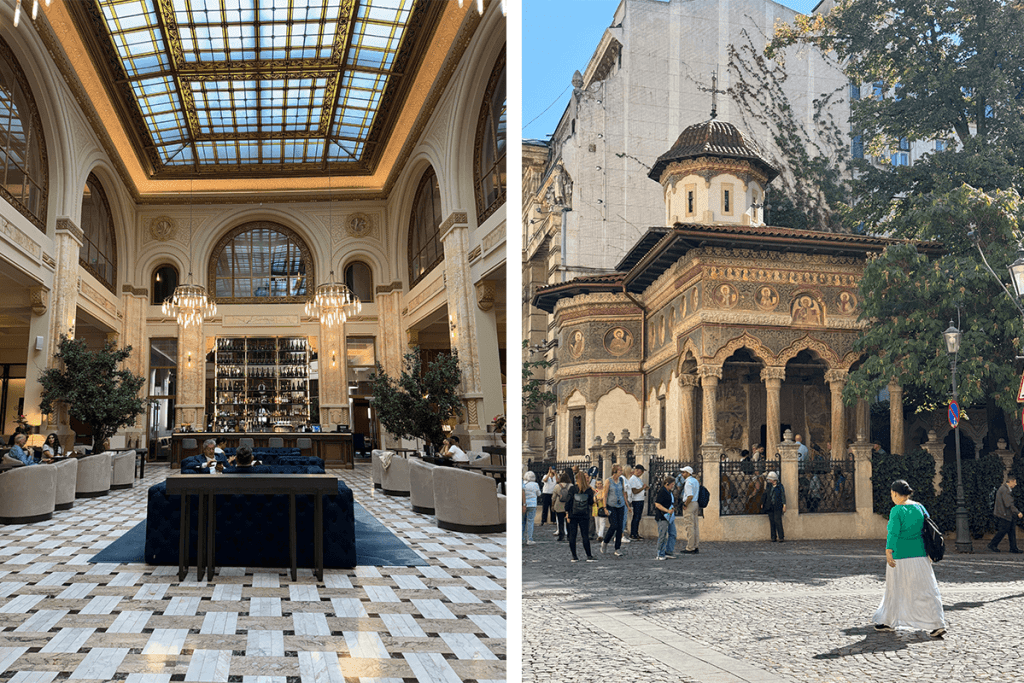
On first impression, Bucharest looks kind of like Paris… if it was in the Soviet Union. One moment you’re on a leafy street lined with Beaux-Arts facades and people sitting on bistro chairs outside cafes, the next, you’re staring at a block of brutalist concrete structures that look about as inspiring as an empty spreadsheet. One of the more beautiful buildings was my hotel, The Marmorosch, kitty-cornered between two main streets in the Old Town. The hotel was once the country’s largest bank, and has very cool bones—a grand marble staircase that brings you to reception, a lounge in an atrium with gold-leaf-trimmed columns and stained glass skylight. I thought the rooms fell flat for such a grand building, but it was a perfectly comfortable stay (especially for $250/night) with a gym, spa, and fun subterranean bar in the bank’s former vault that served a mean Negroni. Most importantly the location was perfect, and walking distance to everything I planned to see.
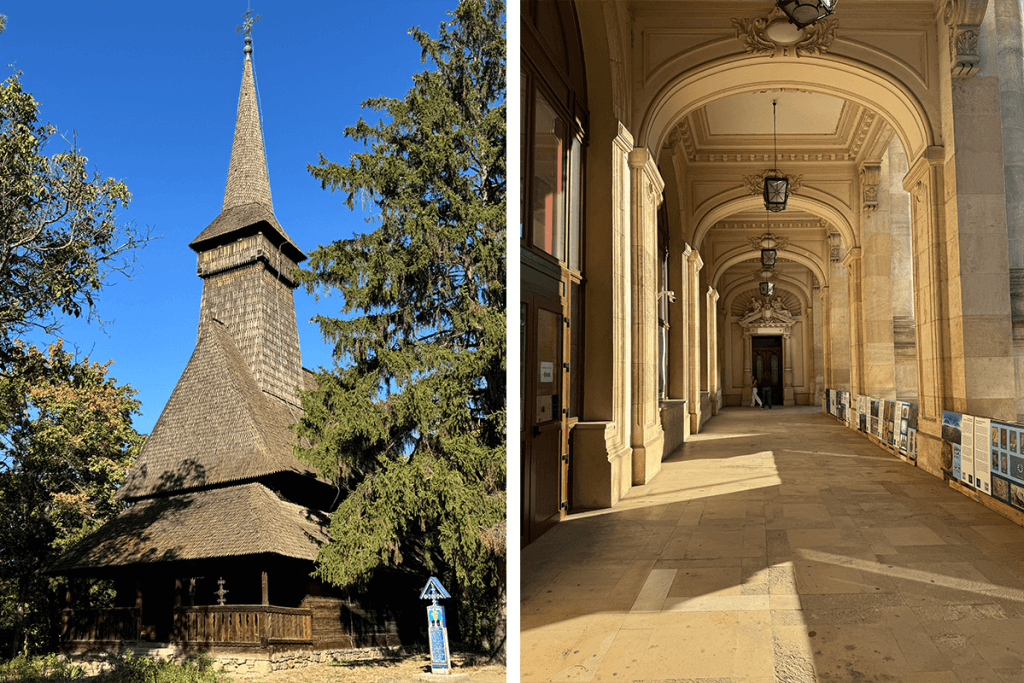
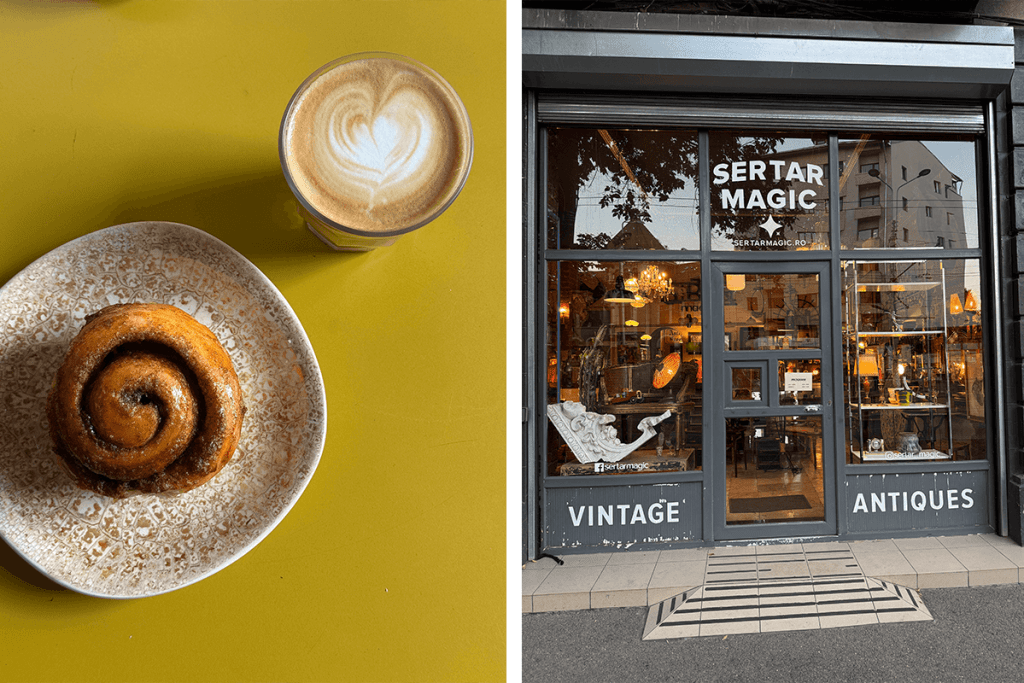
Each morning, I’d go in search of good coffee—some favorite finds were C22, Artichoke Social House, the lobby bar of the Corinthia—then wander to museums, shops, and find myself in the middle of Bucharest’s 566th birthday celebrations. The National History Museum was great, and the Romanian Village Life Museum was maybe the coolest I’ve ever been to—hundreds of peasant settlements and monuments from the 17th to 20th century moved to a 24-acre park from all corners of the country. It really feels like you’ve been transported to another era, surrounded by all sorts of whimsical Seussian wooden homes, churches, and schoolhouses with wells, windmills and gardens weaving throughout.
Beyond the museums, I popped in and out of antique shops with museum-worthy relics—don’t miss Sertar Magic or Circa 1703-3071—and came across an amazing store packed to the gills with fur coats, stoles (many of which had feet still attached), and leather jackets. The shopkeepers looked straight out of I, Tonya, with fanny packs and bleach blonde hair, draped in fur, leather and jeans on an 80 degree afternoon. I seriously considered springing for one of the mink coats, in great condition and only €300 [Romanian Lei is the official currency, though this shop quoted all their prices in Euros], but settled on a leather blazer that would be much easier to pack.
One morning I met Daniela, the tour guide. Born in Transylvania, she grew up in Bucharest and is now a lawyer who moonlights as a guide when she’s not working on her book about riding the Trans-Siberian Railway. A self-proclaimed history nerd, she started our walk in antiquity and as we paced through the cobblestone streets, we inched our way through the country’s grueling history, detailing all sorts of clashes, conquests and coups that shaped the country to what it is today. The principalities of Wallachia, Transylvania, and Moldavia (which make up modern day Romania) were controlled by a handful of empires throughout their history—the First Bulgarian Empire, the Ottomans, Romans, Hungarians—and were seemingly always fighting off some intruding force to retain autonomy. One person who was especially successful at this was Vlad Dracula, also known as Vlad the Impaler, who ruthlessly killed thousands of his enemies, often impaling victims. If the name sounds familiar, he was the inspiration for Bram Stoker’s Dracula, and though the blood sucking was fabricated, vampire folklore runs deep. Daniela weaved in all sorts of legends and stories of vampires and mythical creatures in the forest that I couldn’t tell if she believed or not.
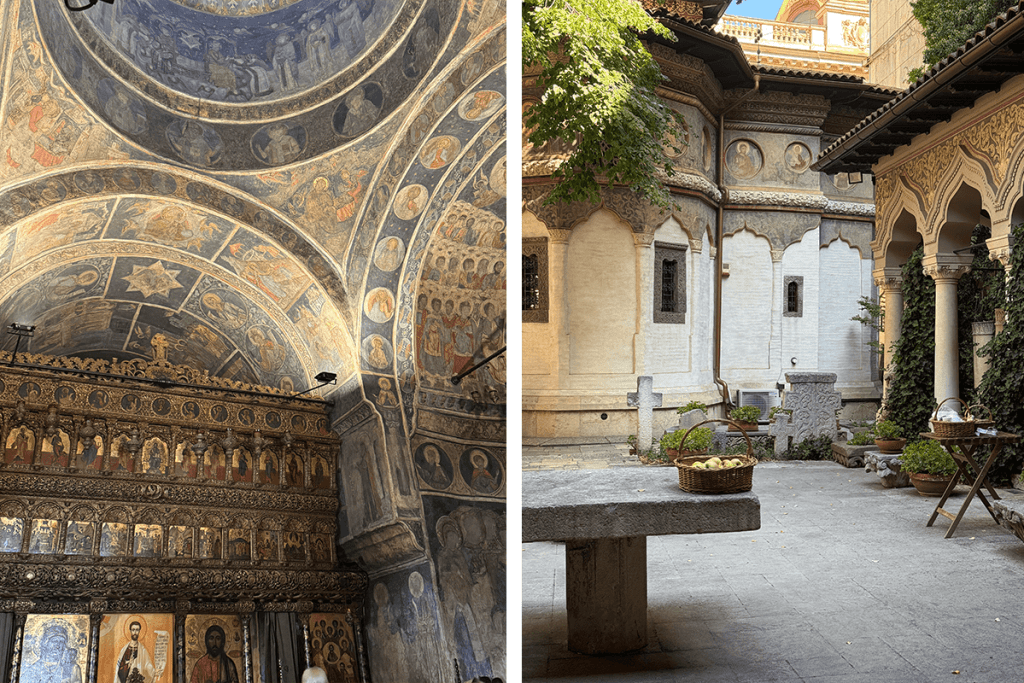
At one point, she noticed the tiny cross on my necklace and said she wanted to show me the Church of the Stavropoleos Monastery. Since it was Sunday morning, we ended up in the middle of the liturgy. The exquisite church is designed in the ornate Brâncovenesc style, with a dim interior and frescoed ceilings. Byzantine chants reverberated against the walls, and light beamed in through tiny windows at sharp angles. She whispered about the head nuns as if they were celebrities, and taught me the Romanian Orthodox sign of the cross—right to left, using your thumb, pointer and middle fingers pinched together—which distinguishes it from the Catholic or Russian Orthodox versions. Apparently centuries ago, this difference alone could mark you for exile. She assured me the stakes were much lower now.
Afterward we lit candles for the living and the “asleep,” and joined the courtyard where people shared homegrown apples and grapes. At that point I completely forgot I was on a tour, but Daniela had a few more centuries of history she wanted to cover. We ended up spending nearly 6 hours together. She told me about growing up under Ceaușescu, the dictator who commissioned elaborate palaces and some of the world’s largest (and ugliest) buildings, while normal families like hers rationed bread and milk. Despite the hardship, she seemed almost nostalgic for that time, and was a card carrying Communist (literally keeping her grandfather’s membership card tucked inside her lanyard). Before we parted, she gave me a list of things to see in Transylvania, but warned me not to drive by myself like I had planned, since the roads (and the drivers) are known to be a bit rough. I thanked her for the former and shrugged off the latter.
Brasov, Transylvania
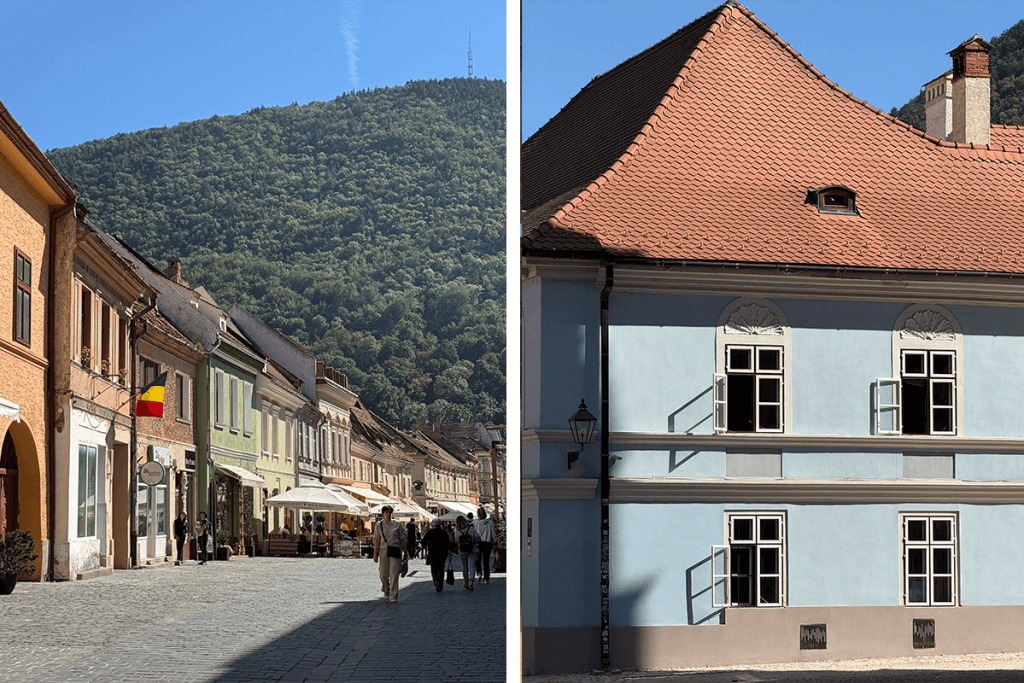
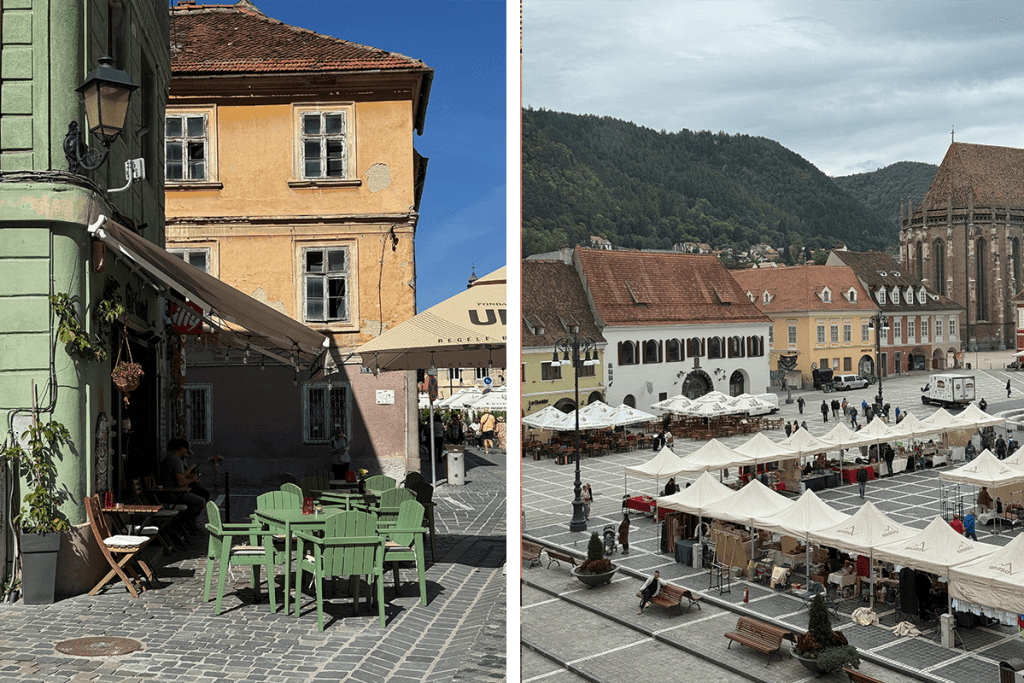
I took the 2.5 hour train to Brasov the next morning to pick up a rental car, except they wouldn’t give it to me without an International Drivers Permit. My meticulously mapped road trip evaporated, but after Daniela’s warning, maybe it was some sort of cosmic redirection. I checked into a small hotel called Casa Wagner on the main square to regroup. Brasov felt a world of a difference from Bucharest with its Gothic and Baroque architecture and pastel merchant house lined streets, surrounded on all sides by thickly forested hills. I spent a day sipping coffee and blueberry juice on the sunny terrace of CH9, browsing craft shops like Inspiratio for ceramics I had planned to source directly from studios, peeking into churches and trying ciorba, a traditional Romanian soup, at Bistro de l’Arte, while live music wafted over from the square down the road. It wasn’t the day I’d planned, but in hindsight, it was nice to shift into a lower gear between the city and my final, much sleepier stop, deeper into Eastern Transylvania.
The next day a very young man who looked like he might have gotten his driver’s license that morning picked me up from Brasov and we started towards The King’s Retreat, the King of England’s aptly named guesthouse in the Zalán Valley. We left Brasov behind and drove through endless fields of wheat and scorched sunflowers, and about an hour later peeled onto a gravel road and began climbing up into the hills. As we climbed up, the tree canopy above us was so thick that at points it felt like we were underwater. Eventually we came across a clearing where two yoked horses munched on the grass, and in the distance I saw an old barn and a few cottages. Not another person in sight. He grabbed my suitcase and we scrambled up the hill to a room with a wide open door and dropped my bags. I thanked him with a “multumsec,” and he was off.
Zalán Valley, Transylvania
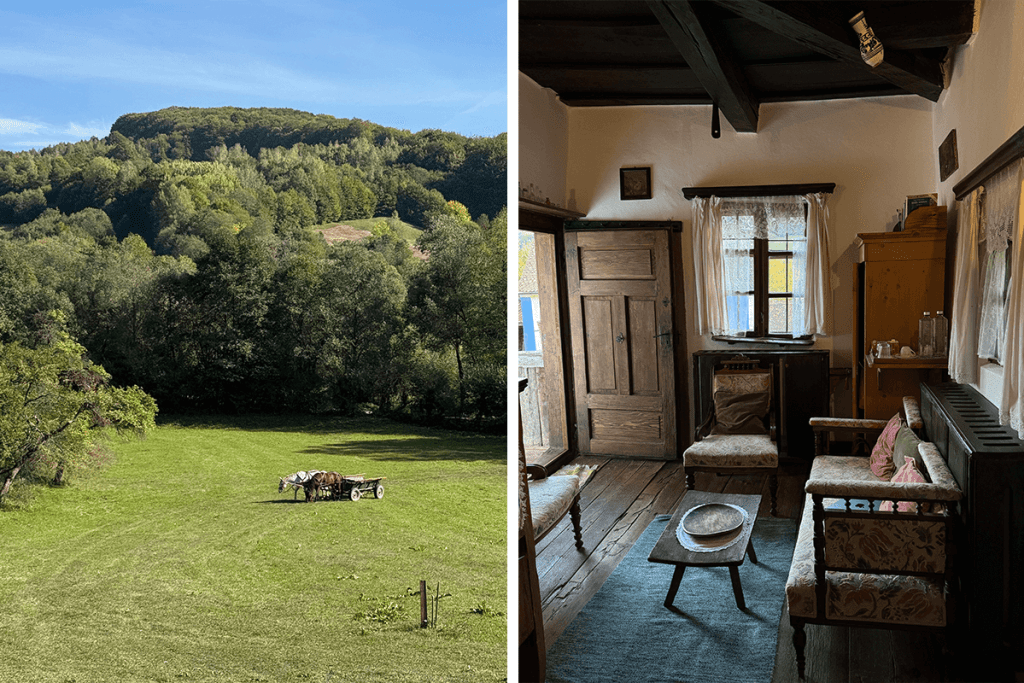
My room was incredible: creaky wooden floors and a black beamed ceiling, hand embroidered lace curtains, and a traditional Transylvanian double-decker twin bed so high off the ground I had to run and launch myself onto it. Nothing really matched—an oriental tapestry hung above a striped rug next to a sun-faded floral upholstered sofa—but it all worked. Every item was antique, sourced from Transylvania, and the layering of it all created that amazing texture that so many places try to replicate but can’t.
I poked my head into a cerulean building that seemed to be the main house. A smiley woman with plump, rosy cheeks appeared and I greeted her with a “buna ziua,” which was about the extent of how we could communicate, as she didn’t speak Romanian, but a Hungarian dialect common in this part of Transylvania. She handed me a piece of paper to write my name and phone number on, and a shot of room temperature palinka for my efforts.
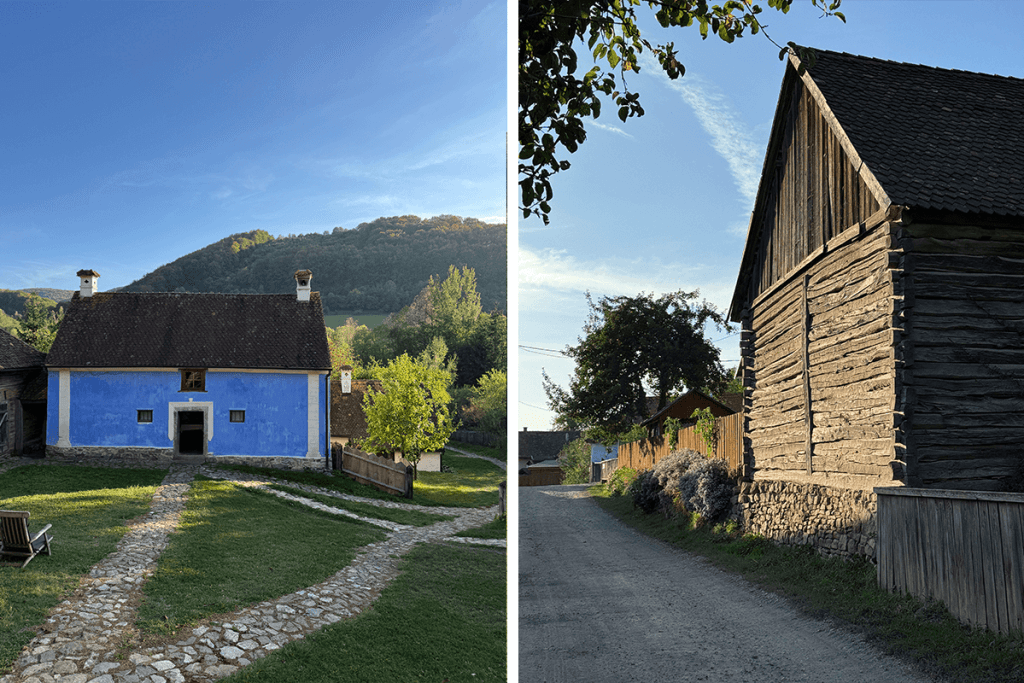
Dinner wasn’t until seven, so I read in the garden, with the soundtrack of cowbells, cicadas and birdsong as the scent of early autumn smoke wafted over from the next valley. Just before dinner, I stepped outside the gate for a walk and met a flushed British man who asked breathlessly, “King’s House?” He had driven not from Bucharest, but nearly 11 hours from Budapest, which made sense in the sort of way you don’t question in places like this. I pointed him uphill and started down the dusty gravel road in my unsensible J.Crew loafers. The entire road had maybe a dozen houses, each with small farm plots, and I saw far more horses than cars. I made eye contact and waved to a stoic farmer through the slats of his wooden fence, who quickly turned back to supervise his sheep as they chowed on freshly scythed grass. If he told me he was 400 years old, I wouldn’t have doubted it.
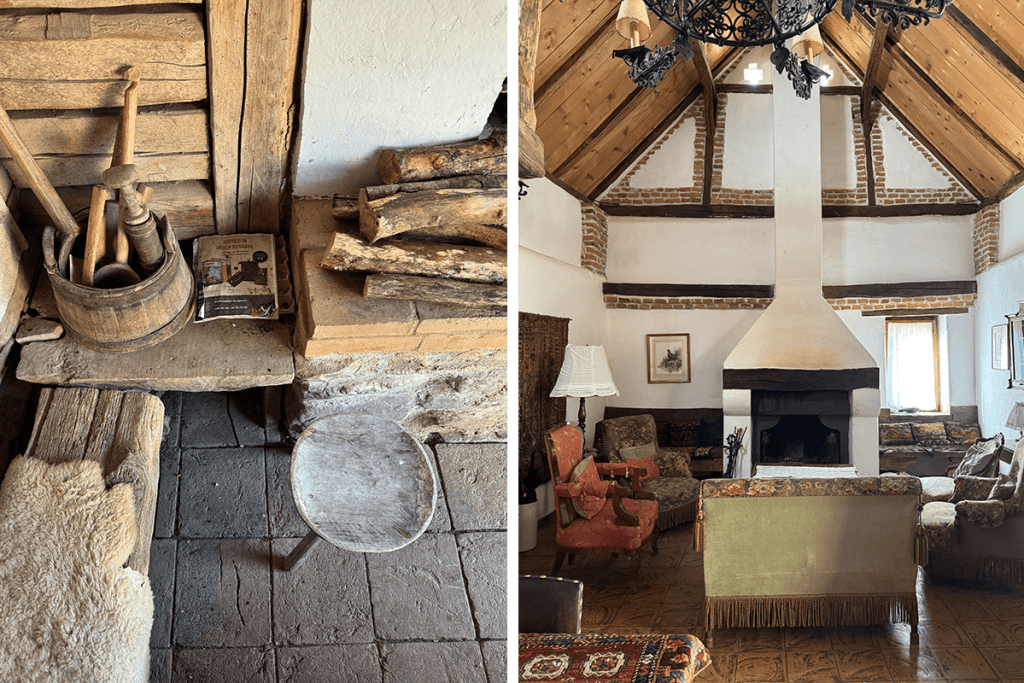
That night at the communal dinner table over more ciorba and palinka, I met a jovial German man who comes by himself for a week every year and was staying in the room next to mine, the British man from earlier, and his two Aussie friends who were staying in the cottages just down the hill. I asked the German all about his visits to this area and if he believed in vampires—which he laughed off. I didn’t tell him I threw some garlic from the grocery store in Brasov in my bag for good measure.
We all retired to our rooms and I slept soundly in my quirky bed with the fresh air streaming in through the leaky single-paned windows. Around 3AM, I woke to someone or something walking up and down the warped wooden deck and rustling with the door next to mine. What was at the door—a person? Animal? Were vampires out of the question? Whatever it was kept coming back. Suddenly I realized my go-with-the-flow plan had left out one crucial element—an exit strategy. There was nowhere to go. No car. No signal. Woods full of hungry bears preparing for winter. Or maybe something worse, if I believed the legends Daniela had told me.
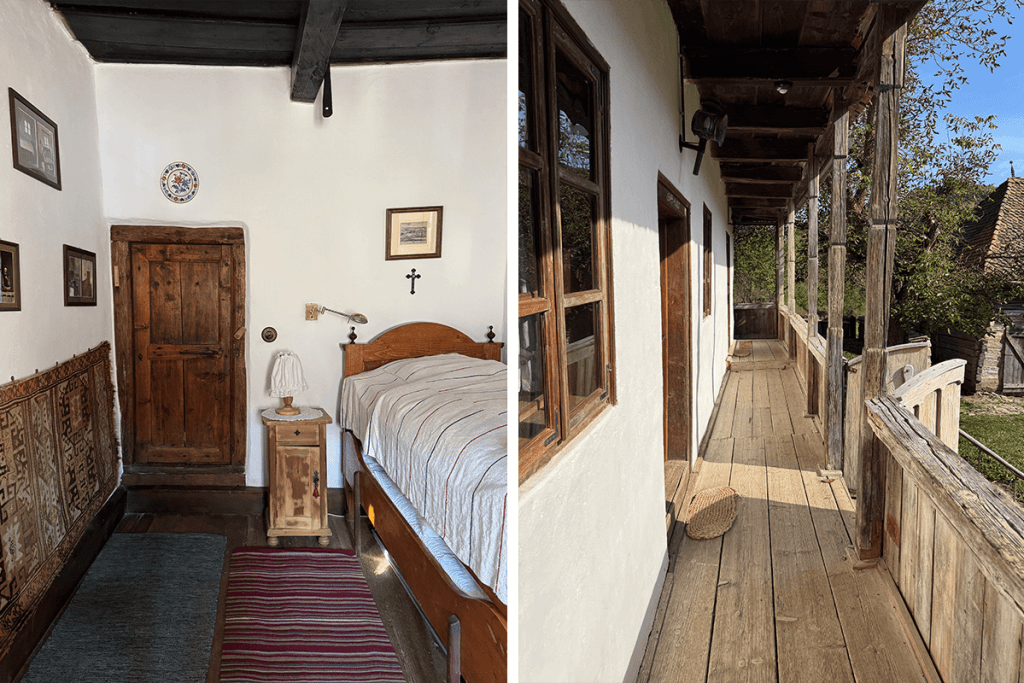
I lay absolutely still. Eventually the ruckus stopped, or I fell asleep, or maybe the whole thing was just a bad vivid dream—I swear I only had one glass of palinka! At breakfast, I casually asked the German man if he went out to look at the stars in the night. He had slept straight through.
That afternoon, I returned to Brasov, then onward to Bucharest, then home. I didn’t see the Peles Castle or the ASTRA Ethnography Museum or drive on the scenic Transfăgărășan Highway or visit the ceramics studios I’d planned. I’m not entirely sure what happened that night, and I’m less sure than I was before about what happened throughout the thousands of years of history Daniela and I sped through. But I was sufficiently enchanted and spooked, and ready to book my return trip to do it all again. Though next time with a car. And hopefully not alone.
Leave a Reply
You must be logged in to post a comment.