I’d been wanting to visit Sardinia since my early 20s, but somehow it never happened. The call of Greece, Sicily, and other islands where I already had friends or connections pushed it down the priorities list. Over the last year, though, my friend who handles the PR for Su Gologone kept asking me to come, and our friend Roberto, who’s been going to the island since the ‘80s, agreed that I would love it. So I decided to stop waiting for the perfect 10-day window for a Sardinia discovery trip and make the most of the four days I had to at least get a taste.

We landed mid-afternoon in Olbia, on the northeast coast, and rented a car from AM Service (thank you to Roberto for the hot tip—highly recommend this local company—we walked right up to the counter, whereas Avis’s line was 20 deep and Sixt was 3x the price with no cars left!). We headed south for a couple of hours to Su Gologone, an “experience hotel” in the wild and mountainous region of Barbagia. I’m not going to go into every detail of this place, because I don’t want to spoil the surprise. Let’s just say that if you’re someone who is very into food, love a family-owned property (opened in 1967, third generation, run by women!) that is very dal cuore (from the heart), put this high on your list.

The area is so rich—when you ask locals where they’re from, they tell you the name of their village, and each village on the island has its own traditions and dialect. I felt like we barely scratched the surface during our short stay. On our one full day, we walked 10 minutes down the road to the Su Gologone spring, a mystery that has attracted divers for decades who want to reach its depths (the latest dive came in at 135 meters), and whose limestone caves supply the hotel with all its water. I was determined to find a fede sarda (Sardinian engagement ring), so next we headed to Dorgali, a town about 20 minutes away that has a number of shops, some with these beautiful handmade rings, and others with traditional woven textiles. (Read about my hunt and the ring I finally settled on here!)

We had to make it back in time for lunch so we could try the fish that the very enthusiastic waitress at the bar-restaurant had urged us to try, but I wanted to take a quick detour to the sea, since those signs to Cala Gonone were calling me. It was literally a beach driveby, which I justify as research for the next trip, but we made it back in time for an epic lunch (fregola with mixed seafood, a Sardinian pasta that’s similar to pastini, and a pesto bocciu, which is like cavatelli). Afterwards, we walked through the Bottega dell’Arte, the gallery where artist/owner Giovanna creates and sells her unique pieces, then their massive gardens that supply the restaurants. We were about to set off on an epic mountain sunset hike, but the weather gods didn’t cooperate. Nevermind—now we know how much we missed, namely visiting towns like Oliena, Nuoro (for the textile museum), and Orgosolo, and we can’t wait to come back to see Giovanna, and another fireside meal of the best pork of our life.

From the mountains, we headed north to the Costa Smeralda. I have to be honest, even after all of my years of working in travel magazines, I really had no visual reference for it. Sure, I had seen plenty of images from the ‘70s of Marisa Berenson decked out in Pucci against the bright Sardinian backdrop, but nothing that gave me a true sense of it. I had imagined it as a built-up, glitzy, not-my-vibe kind of place, with no idea that the Aga Khan, who in the early ‘60s transformed this rugged coastline into a holiday village for the jet-set, had from the start envisioned carefully integrating his development into the environment, with complete respect for nature. It’s a rare combination—especially then—and still today, when viewed from the road or sea, most of the structures are seamlessly built into the landscape. I also couldn’t get over how uncrowded the area was—granted, we were traveling in mid-September, which for most of the Mediterranean isn’t the end of the season, but it is there. (Good to know for all of you who like to travel in June and early July: Sardinia’s high season is mid-July to late August; avoid that and you won’t have to deal with traffic, overbooked restaurants, and billionaire behavior.)

We were staying at the Romazzino, which was built in the ‘60s and came under the Belmond umbrella this year. We loved its architecture, old-school details and vibe. We got there just in time for an excellent lunch at their seafront restaurant, Èntu e Mari, and were joined by Roberto and Anna, who decided at the last minute to come from Rome for the weekend. We ordered an incredible local vermentino to enjoy with our fritto misto and simple/perfect pasta aglio olio and peperoncino, which called for a big post-lunch nap on a lounger.

Early the next morning, our friends Roberto and Anna brought us to the marina, where we rented a boat and headed to Mortorio, a small uninhabited island about 15 minutes away. As we neared it, Roberto got so excited—with no other boats there, we had it to ourselves, a super rare situation. The water was as gorgeous as everyone who is a Sardinia fan had always told me—it went from Caribbean blue near the shore to a turquoise I’ve only seen in Greece, plus it was so clean and full of fish. We were so lucky to have the sea to ourselves for an hour before other boats started to arrive, at which point we headed back to the port to get in our full day of exploring.

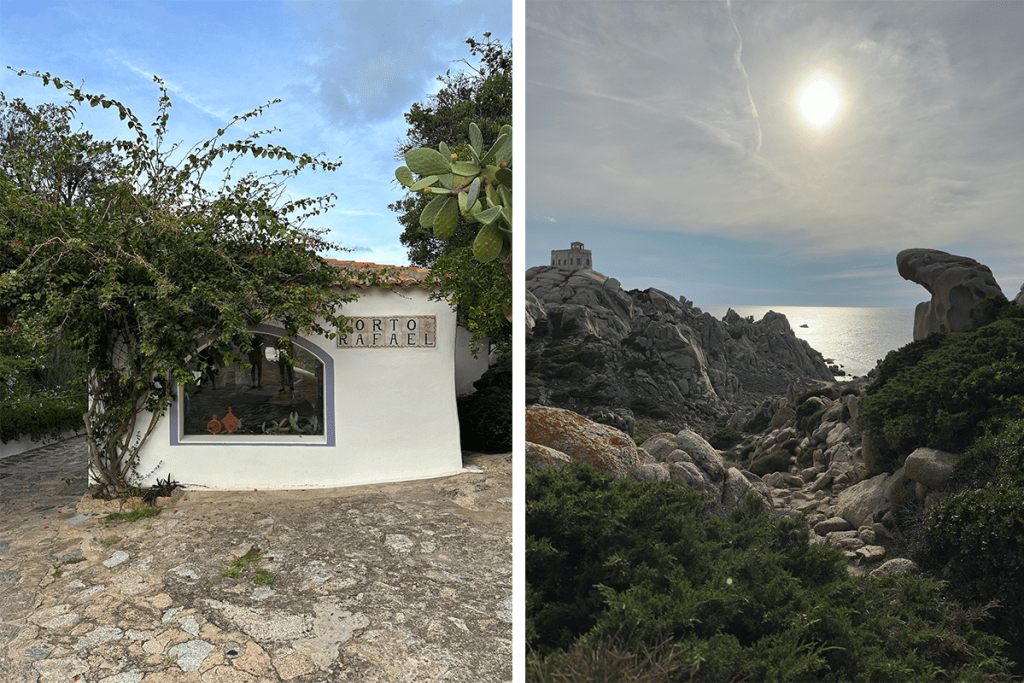
Roberto brought us to J Beach, a very cool seaside restaurant and beach club with loungers, where we had one of the best meals of the trip—another local vermentino, local lobster with homemade pasta, followed by another post-lunch seaside nap. (Consistency is important!) From there, we ventured north—Roberto and Anna were determined that we should see as much of the north of the island as possible. We stopped at Capo Testa, the northernmost point, from which you can see Corsica and the chalky cliffs of Bonifacio, and hiked around its fantastic rock formations. Then we drove to have cocktail hour in the town of Porto Rafael, a place with an incredible origin story (look it up!) that makes many locals act like they’re looking at a puppy when they’re talking about it. Matt said it reminded him of Montecito, and he didn’t like the real estate agent offices that took over most of the town square, but I fell for its charm.
On our last morning, we hiked the Pevero Trail just a couple minutes’ walk from the Romazzino, which paralleled the sea. We billy-goated down to some sweet little beaches without a soul around, and planned our return trip. It’s only a 40-minute flight from Rome, after all. See you there in May or June, for a solid week at least!


Leave a Reply
You must be logged in to post a comment.